The commercial property landscape is evolving fast. “Smart building” is no longer a differentiator – it’s the baseline expectation.
For developers and landlords, delivering a connected building is no longer just about installing systems. It’s about ensuring those systems work together seamlessly from day one.
And that shift has fundamentally redefined the role of a networking & connectivity specialists like Simpli-Fi.
Why BMS Providers Need Early Connectivity Alignment
In modern developments, connectivity is no longer a supporting layer- it is the foundation that everything else depends on.
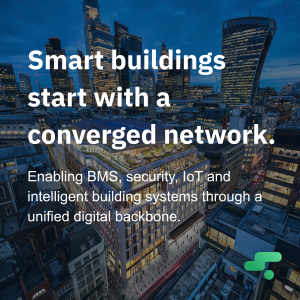
At CAT A stage, landlords are now responsible for delivering a converged network – a unified digital backbone that supports both:
- Operational Technology (OT) – BMS, HVAC, security, lifts
- Information Technology (IT) – WiFi, tenant systems, AV, user services
Rather than deploying multiple siloed networks, this approach uses a shared fibre and copper infrastructure, typically segmented via VLANs, to support all building systems.
The result?
- Reduced infrastructure duplication
- Lower cabling and lifecycle costs
- Greater scalability and flexibility
- A platform for real-time data and analytics
But more importantly, it creates the conditions for true system integration.
What Runs on a Converged Landlord Network?
For BMS providers and system integrators, the converged network is the environment your systems must operate within.
And that environment is becoming increasingly complex.
- Building Automation & Core Systems
- HVAC systems for remote monitoring, optimisation and energy efficiency
- Smart lighting, including PoE-based systems responding to occupancy and daylight
- Lift and elevator systems integrated for monitoring and emergency control
- Security & Life Safety Systems
- IP CCTV and video surveillance
- Access control systems including smart entry and turnstiles
- Intercoms and communication platforms
- Fire and life safety systems, often integrated with HVAC and lift controls
- Utility & Energy Management
- Smart metering across power, water and gas
- Energy Management Systems (EMS) for optimisation and reporting
- Data-driven sustainability and ESG performance tracking
- IoT & Environmental Intelligence
- Air quality and environmental sensors (CO₂, temperature, humidity, noise)
- Occupancy and motion sensors for space utilisation
- Leak detection systems for risk mitigation
- Occupier Experience & Digital Services
- Building-wide WiFi and roaming services
- Digital signage and AV systems
- Smart parking and access systems
- VoIP and unified communications
The Challenge: Integration Without Alignment
Each of these systems is typically delivered by a different provider.
Each has different:
Without early alignment, this leads to:
- Over-engineered or duplicated infrastructure
- Systems that technically function- but don’t integrate
For BMS providers in particular, this creates a major risk:
being expected to integrate into an environment that wasn’t designed for integration.
The Role of MSI in Smart Building Delivery
This is where Master Systems Integration (MSI) becomes critical.
MSI ensures that:
- All systems are designed with interoperability in mind
- Network infrastructure supports every stakeholder’s requirements
- Data can flow between systems in a structured, usable way
At Simpli-Fi, we’ve formally integrated MSI into our service offering – because it’s now essential to delivering smart buildings successfully.
Our approach includes:
- Document audits to identify gaps and clashes early
- Stakeholder workshops to align BMS, security, AV and IT providers
- Network design aligned to system requirements
- End-to-end delivery and validation
Creating a Single Pane of Glass (SPOG) Environment
When convergence and MSI are done properly, the result is a Single Pane of Glass (SPOG).
This allows facilities and operations teams to:
- Monitor all building systems from one interface
- Access real-time performance data
- Automate responses across systems
- Improve efficiency and occupant experience
But SPOG is not a software add-on – t’s the outcome of getting the infrastructure and integration strategy right at CAT A.
Real-World Insight: A Complex City Development
On a recent City project, the level of system complexity required a fundamentally different approach.
Multiple stakeholders. Multiple systems. Multiple expectations.
Our role extended far beyond connectivity delivery. We:
- Led cross-discipline workshops to define system requirements
- Conducted detailed design and documentation reviews
- Aligned all subcontractors to a shared infrastructure strategy
- Ensured readiness for full system integration and future SPOG delivery
This is increasingly the norm – not the exception.
Partnering for Smarter Building Outcomes
For BMS providers, system integrators and smart building specialists, the takeaway is clear:
Your systems are only as effective as the infrastructure they sit on.
A well-designed converged landlord network enables you to:
- Integrate more easily with other building systems
- Deliver better data and insights
- Reduce deployment friction and rework
- Provide greater long-term value to clients
A poorly designed one does the opposite.
Final Thought: Build for Integration, Not Just Installation
Smart buildings are not defined by the number of systems they include – but by how well those systems work together.
That integration starts at CAT A, with a converged, MSI-led connectivity strategy.
For landlords, developers, and system providers alike, the opportunity is clear:
collaborate earlier, design smarter, and build on a shared digital foundation.
Are you a BMS provider or system integrator looking for a connectivity partner who understands integration from day one?
Simpli-Fi works alongside building technology partners to design and deliver converged network infrastructure that enables smarter, more connected buildings.
Let’s talk.
hello@simpli-fi.co.uk
simpli-fi.co.uk
Frequently Asked Questions
What is MSI in smart buildings?
Master Systems Integration (MSI) is the process of coordinating and integrating all digital building systems into a single, unified platform to ensure seamless performance and interoperability.
Why is CAT A connectivity important for BMS providers?
CAT A connectivity provides the foundational infrastructure that allows BMS and other systems to integrate effectively, avoiding costly redesigns and ensuring optimal performance.
Follow Simpli-Fi on LinkedIn for more connectivity insights and real-world case studies.